Why Spatial Displays Need Their OpenXR Moment
Imagine walking into an architecture studio. Along one wall, several designers sit at their workstations. On their displays, a new building is taking shape—layers of geometry, structural elements, lighting studies. But these are not flat renderings. The model extends out from the screens with real depth, allowing the designers to understand proportions and spatial relationships at a glance.
A few meters away, another architect is wearing a headset. Instead of sitting at a desk, she walks slowly through the office, fully immersed in the building itself. She can step inside the lobby, inspect the ceiling structure, and look up through the atrium toward the glass roof.
But something interesting happens when she turns back toward the desks. On the spatial displays of her colleagues, she can see the same building emerging from their screens. From her perspective inside the headset, those displays appear as surfaces in the room—portals into the shared model. She can see the part of the structure a colleague is currently editing, floating just beyond the edge of the screen.
The workstation users and the headset user are not looking at separate versions of the project. They are interacting with the same spatial scene, through different devices.
Now take it a step further. Another architect joins remotely from another office. On his spatial workstation display, the same building appears anchored to his screen. In the headset view of the local architect, his edits appear immediately in the shared space. The remote display itself appears as another surface in the virtual environment, just like the screens in the physical office.
No one is screen sharing.
No one is exporting files.
They are simply interacting with the same spatial environment.
Spatial Computing is Not a Device
When people talk about spatial computing today, they usually imagine a headset.
Virtual reality headsets.
Mixed reality headsets.
Devices like Vision Pro or Quest.
This association is understandable. Headsets were the first systems capable of delivering truly immersive spatial experiences. They demonstrated that interfaces could be built around space itself rather than around flat windows on a screen.
But spatial computing is not a headset.
It is a different way of organizing digital information—one where content exists in three dimensions, where interfaces respond to the position of the user, and where digital objects can be anchored to the physical world. Once you look at spatial computing this way, a different picture emerges.
Headsets are only one possible portal into that spatial environment.
And they will not be the only one.
Headsets Solved the First Software Problem
Early VR systems suffered from a familiar issue: fragmentation. Each headset vendor shipped its own SDK. Applications had to integrate device-specific code to handle tracking, view configuration, and rendering. Supporting multiple devices quickly became difficult. The XR ecosystem eventually converged around a shared interface: OpenXR.
Instead of writing applications for individual devices, developers could now target a common abstraction. Applications describe spatial scenes in terms of poses, views, and projections. The runtime then translates that description into device-specific rendering. This interface layer proved critical. It allowed the hardware ecosystem to diversify while keeping the developer platform unified.
More recently, OpenXR has even begun to support persistent spatial anchors and spaces, allowing digital objects to remain attached to locations across sessions and devices.
In other words, the foundations of a shared spatial environment are already emerging. But they currently apply mostly to headsets.
Spatial Computing Will Not Live in Headsets Alone
Computing platforms rarely converge to a single device. They expand across form factors. The personal computer did not eliminate laptops. Laptops did not eliminate smartphones. Each device occupies a different position in the spectrum between mobility, immersion, and performance.
Spatial computing will follow the same pattern. Headsets will remain the most immersive portal into spatial environments. They allow users to walk through scenes, interact with digital objects at full scale, and experience environments from within.
But headsets are not always the ideal environment for everyday work. Many professional workflows still happen at desks, on powerful machines, using keyboards, mice, pens, and large displays. Engineering, design, simulation, financial analysis, and media production often require hours of focused work with high-performance GPUs and precise input tools.
This is where spatial displays become important. They bring depth perception and spatial interaction into the workstation environment without requiring users to leave the desk. We are already seeing the first wave of these displays emerging across laptops, monitors, and tablets.
The Rise of Spatial Displays
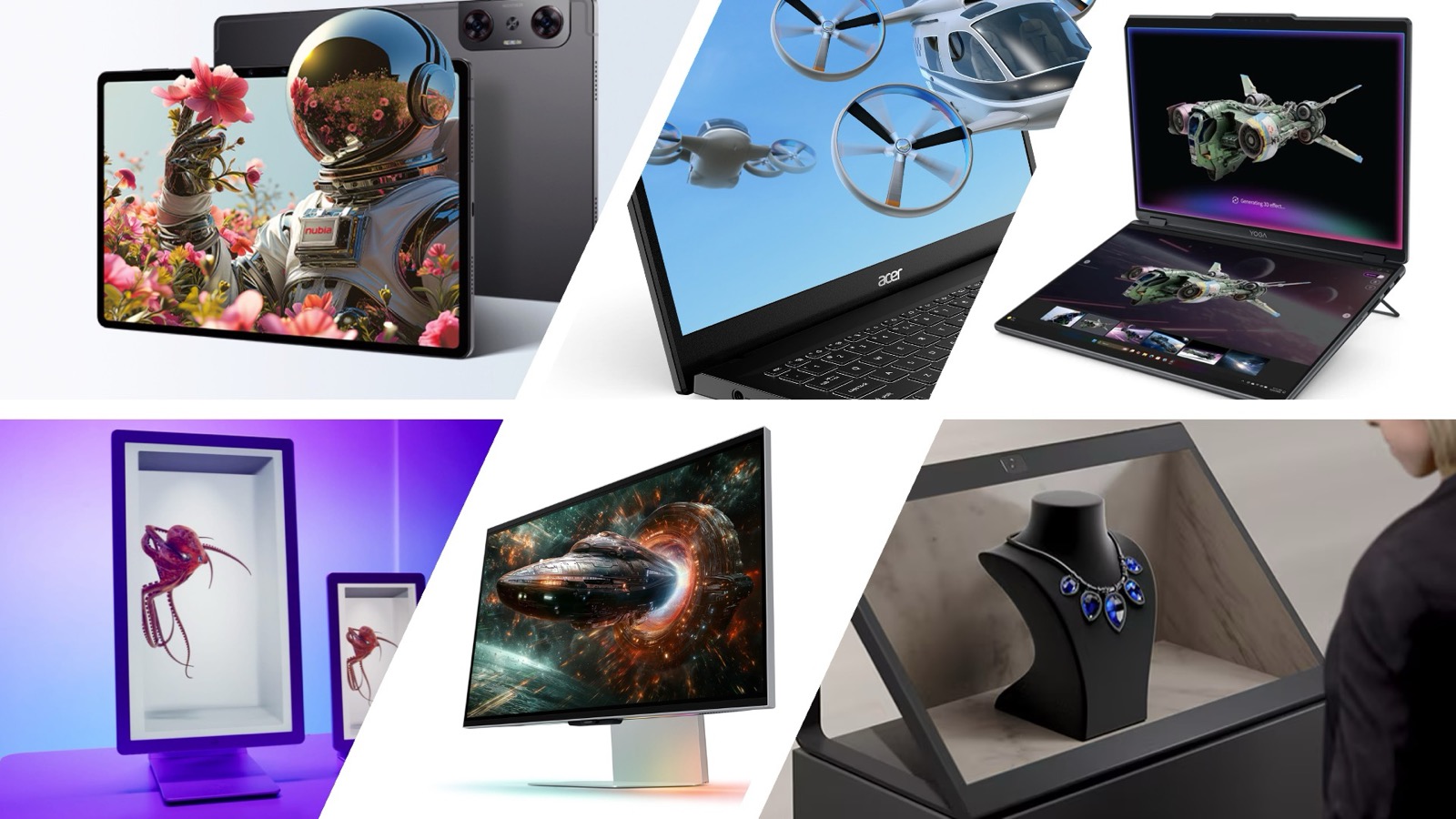
A new generation of displays is beginning to emerge that can present digital content with real depth while preserving the familiarity of traditional screens. Instead of rendering a single flat image, these systems generate multiple views and deliver them to the viewer in ways that create natural depth perception. Many incorporate head or eye tracking to adapt the rendered views dynamically to the user's position. From the perspective of software, these displays behave less like monitors and more like tracked spatial surfaces.
A display now has:
- a physical position in space
- a geometry and viewing volume
- a viewer whose position may change
- a requirement for multiple perspective views
In other words, the screen itself becomes part of the spatial computing environment.
And this category is growing quickly, with major OEMs beginning to ship spatial display devices across laptops, monitors, and tablets. But unlike VR headsets, spatial displays currently lack a shared software interface.
The Missing Interface Layer
Today, most spatial displays rely on proprietary SDKs, with applications rendering content in device-specific formats and integrating each display individually. This keeps spatial displays fragmented and prevents them from scaling as part of a broader ecosystem.
If spatial displays are going to participate fully in spatial computing, OpenXR will need to be extended to account for how these displays actually work, and to allow applications to reason about spatial screens in a consistent way.
Such an interface would expose a few key ideas:
- Displays should be represented as spatial surfaces with known geometry, pose and capabilities.
- Applications should be able to request view configurations appropriate for the display type (tracked stereo, multiview, etc...).
- The display-aware runtime should handle session management, compositor orchestration, and the standard OpenXR interface.
- Vendor-specific processing (interlacing, calibration, eye tracking) should live in a separate layer beneath the runtime, owned by the hardware vendor.
In other words, the application describes the spatial scene through a standard API. The runtime manages how that scene is composited. And a vendor display processor handles how the composited result reaches the specific hardware.
Toward a Shared Spatial Environment
Once such abstractions exist, spatial displays can become first-class participants in the spatial ecosystem.
- A headset user could see spatial displays in the room as portals into the same scene.
- A workstation user could interact with spatial objects emerging from their screen.
- A remote collaborator could join the same environment from another spatial display or headset.
Different devices would simply provide different viewpoints into the same spatial world.
Spatial computing would stop being tied to a particular device.
It would become an environment shared across many of them.
The Next Platform Layer
Every major wave of computing required a new interface layer.
Graphical user interfaces unlocked the personal computer. Mobile operating systems unlocked the smartphone. XR runtimes unlocked immersive headsets.
Spatial computing will likely require another layer—one that allows different devices to participate in the same spatial environment.
Headsets started this transition. Spatial displays are now becoming another important class of spatial devices. But until they gain a shared abstraction layer, they will remain isolated islands of hardware.
The future of spatial computing will not belong to a single device.
It will belong to many devices sharing the same space.